



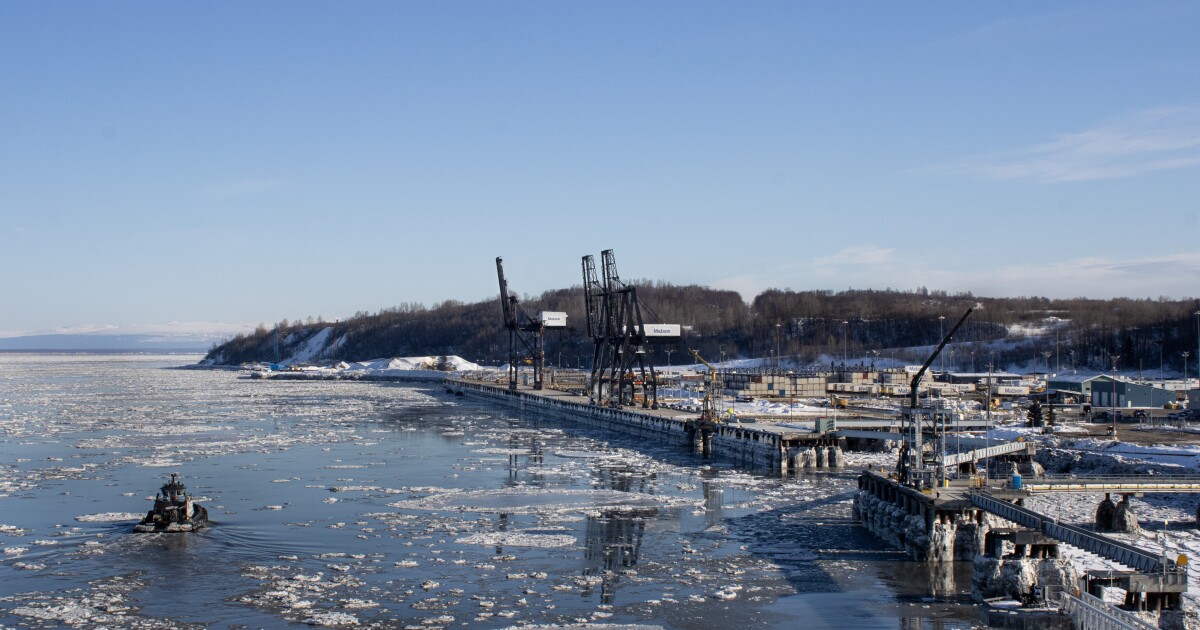
Work is underway to rebuild an important cargo dock in Anchorage, part of a larger $2.7 billion project to improve the Don Young Port of Alaska that began in 2014.
The rebuilding of the port’s Cargo Terminal 1 began March 16, following an official “notice to proceed” from Anchorage Mayor Suzanne LaFrance. It’s just the latest phase of the Port of Alaska Modernization Program and represents the largest capital project since Anchorage became a municipality in 1975.
The port “is a critical piece of infrastructure, not just for Anchorage residents, but for most residents of the state of Alaska,” LaFrance said.
The larger project aims to upgrade the entire port and address its aging and corroding terminals. The upgrade will allow for larger vessels while adhering to the latest seismic design standards.
New terminals are critical to fulfilling Alaska’s cargo and fuel needs and maintaining the state’s role in national defense, according to city and port officials.
About 75% of the state’s inbound cargo comes through the port, driving more than $14 billion in statewide economic activity annually, the officials said.
The port welcomed Mayor LaFrance and reporters March 18 for a tour with Port Director Terry Umatum and Project Director Eric Adams, with Jacob’s Engineering.
“It’s important for the community to know that there’s a team down here making sure that this port operates on their behalf every single day, so every ship that comes in, every fuel barge or cement ship, can offload their goods for the people of Alaska,” Umatum said. “This port, and this infrastructure, has not been maintained to the levels it should have been over the last 50 years, and we are now excited to fix that problem.”
The port has three cargo terminals and, after the mayor’s notice, crews got started thawing ground, installing offices and temporary pads and demolishing the existing Cargo Terminal 1, known as T1. Shipping company Matson is the primary user of the terminal, where it mainly offloads oil, petroleum and lubricants.
Under the modernization project, the three cargo terminals will become two terminals. The work is not expected to interrupt the shipment of cargo through the port.
The work on T1 is estimated to cost $807 million, $50 million of which is covered by federal funds awarded to the city in 2024. According to city officials, the rest will be funded through tariff-supported revenue bonds.
The city approved borrowing up to $1.76 billion for the entire port modernization project, to be paid back through port revenues, including cargo-related fees and tariffs.
As an example, the port’s cargo surcharge was $4.89 per ton in 2025 and increased to $8.05 per ton on Jan. 1, according to a comprehensive plan for the Port of Alaska Modernization Program.
According to the plan, carriers like Matson could wholly pass costs to shippers, like Costco or Walmart, who could then pass the charges onto their customers.
City estimates suggest the overall consumer impact would be minimal if costs are passed along to consumers, but surcharges could increase if additional outside funding, including money from grants, is not secured.